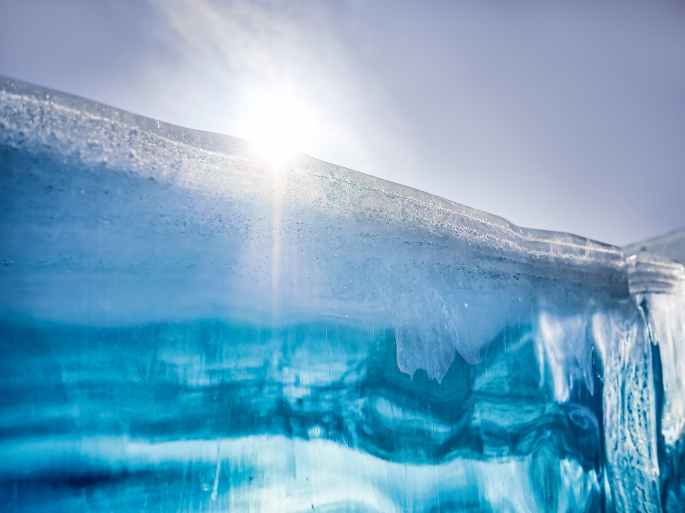
If you like those out of the way places that are hidden gems then you will love the Heise Hot Springs located near the Snake River close to Idaho Falls. This resort has been family run since 1898 and it offers many fun activities for tourists and even locals. Fun things include a 350 foot water slide that is wonderful for all ages, a nine hole golf course, swimming pools, and even float and fishing trips down the Snake River. There are two options for housing and this includes the RV park where you can park your own RV or else you can stay in a two bedroom cabin. The hot springs are closed in November, but are open for your enjoyment the rest of the year. The hours of the Heise Hot Springs are 8 am until 10 pm daily Memorial Day to Labor Day and in the winter from 2 pm to 10 pm on weekdays and Saturday and Sunday from 10 am until 10 pm. The fee for entrance is $6 for adults and $3 for kids under 11. This makes for an ultra affordable vacation if you are on a budget and even if you aren't you will still appreciate an affordable outing for your entire family for once. The hot springs are located at 5116 E. Heise Road in Ririe, Idaho. If you are traveling by RV in Idaho you must include the hot springs on your list of things to do. There are of course many other fun activities in Idaho as well include mining era towns, museums, canyons, and even theme parks. When you think of places to vacation Idaho might not jump to the top of the list but there are many beautiful places in this great state and lots of fun things to do. You will be surprised at all Idaho has to offer not to mention relieved at the affordable prices of many of the tourist attractions. There is a website that has great information on USA Vacations and Unique Travel Spots Listed State By State and Season, the website is called: Seasonal Vacation Spots, and can be found at this url: http://www.seasonalvacationspots.com By Robert W. Benjamin Copyright © 2007 You may publish this article in your ezine, newsletter, or on your web site as long as it is reprinted in its entirety and without modification except for formatting needs or grammar corrections.
Tag: vacation discounts
Annual Travel Insurance
Annual Travel Insurance covers you for every holiday you take for twelve consecutive months. Annual Travel Insurance is generally meant for people who take more than one holiday every year. If you are taking a three-week holiday in some destination during summer and another holiday later in the year, then Annual Travel Insurance could help you save money. Because, if you hold an Annual Travel Insurance, there is no need to spend money for purchasing insurance every time you travel. Annual Travel Insurance is an insurance policy or contract under which the insurance company agrees to pay for loss or damage or injury encountered by you during your trip. This includes trip cancellation, evacuation, medical emergency, baggage loss etc. If you hold proper Annual Travel Insurance then your worries or anticipations regarding your safety during the trip will be no more. Annual Travel Insurance policies cover you for one year with an unlimited number of trips. That means, you can have unlimited number of holidays or business trips as you wish and have a guarantee that for all the trips for the next twelve months you will always be covered. During this one year, you can travel as many trips you like, but no trips should exceed the maximum number of days you have selected in your policy. Annual Travel Insurance policy will cover you for a period of one year from the start date you choose. So, one has to be careful in mentioning the start date in the policy. Annual Travel Insurance gives you superior cover levels and reduced excess payments that you need to pay to make your travel insurance claim. Burglary, hijack, hospital expenses, flight delay, travel delay, cancellation, evacuation - everything is covered in a better way if you hold an Annual Travel Insurance. Annual Travel Insurance gives you complete peace of mind all throughout the year and also gives cover to your delayed baggage, loss of personal items or cash, or passport documents. Obtaining an Annual Travel Insurance policy is very simple. First, select the destinations you wish to be covered for the next consecutive twelve months, and then select the date you want your Annual Travel Insurance to start. After that you have to clear what kind of party you need to cover, that is whether you go for single person, family, couple, group of people etc. and their age groups.
An overview of Poland for Travelers
Poland has a unique history in Europe, often pulled between Russian and Western interests. It you are planning a trip to Poland, here is some background information your should know. An Overview of Poland for Travelers The official name of the country is the Republic of Poland. It covers an area of roughly 120,000 square miles, about the same size as the State of New Mexico in the United States. The capital of the country is Warsaw, which is also the biggest city by population with nearly 1.7 million residents calling it home. Other cities of significance include Lodz with a population of just fewer than 800,000, Krakow with 760,000 residents and Gdansk with 460,000 people. The terrain of Poland is primarily flat although mountains can be found in the region along the southern border of the country. Citizens of the Republic of Poland are known as Polish. The most recent census found there 36.8 million people living in the country, though some are undocumented aliens. The annual growth rate for the population is stagnant, neither growing nor declining sufficiently to be considered to be changing from a statistical point of view. Unlike many European countries, Poland is primarily populated by its own people with Polish people making up 98 percent of the ethnicity. A smattering of German, Ukrainian, Belorussian and Lithuanian people also live in the country. Poland is a predominantly uniform religious country. Over 90 percent of Poles subscribe to the Roman Catholic faith. Followers of Eastern Orthodox, Uniate, Protestant and Judaism can also be found. The literacy rate in Poland is over 98 percent, on par with rates throughout much of Europe. The official language is Polish, which is also the dominant language actually used by the citizens of Poland. Life expectancy for Polish men is 70 years of age, while women life an extra nine years on average, a marked difference. Poland is often overshadowed by Hungary and Czech as a travel destination in the former bloc countries of the Soviet Union. This gives you an opportunity to experience it before the fast food joints of the west start taking over the quaint country.
An Overview Of Switzerland For Travelers
The official name of Switzerland is the Swiss Confederation. If you are considering visiting Switzerland, you should know something about the country. An Overview of Switzerland for Travelers Switzerland is uniquely positioned in Europe because it sits on the crossroads of many routes. Although not as important in modern times, the geographic position explains the odd situation where the official languages of the country are German, Italian and Romansch. French is widely spoken in the west and English is prevalent throughout the country. There is no language unique to Switzerland…Switzerish perhaps. Switzerland is a very modern country rating at or near the top of all living standards in the world. Literacy rates are near 100 percent, 25 percent of adults hold diplomas from higher education and religious freedom is guaranteed. Switzerland has one of the highest usage rates of computers and the Internet, not to mention a high per capita income level. Health care services are outstanding and nearly all Swiss are insured. Historically, Switzerland was first inhabited by Helvetic Celts. It eventually came under the rule of the Roman Empire. During this period, it flourished as cities such as Geneva, Basel and Zurich served as major commerce centers in the Roman Empire. After the fall of the Roman Empire, Switzerland was invaded and ruled by various groups. It later passed into control of the popes of the Roman Catholic Church. Eventually, the three dominant families in Switzerland agreed to a joint rule pact in which they pledged joint defense, peace and autonomous rule. They signed the agreement on August 1, 1291, a day now considered Nations Day in Switzerland. Following this period, Switzerland pursued land capture through military ventures, defeating the Habsburgs on three separate occasions. They were subsequently defeated by the French and Venetians and renounced expansionist policies, the foundation of Swiss Neutrality. After a brief civil war between Protestants and liberals, Switzerland settled into the country it is today in 1848. Free of Catholic rule, the country passed a constitution establishing strong civil liberties. Unlike most countries, the Swiss federal government is very weak. The states, known as cantons, have significant autonomy and the effective law makers in the country. The citizens of Switzerland go by the name “Swiss.” The population totals about 7.3 million and grows less than one percent a year in size. Religiously, Swiss categorize themselves as Roman Catholic 42 percent, Protestant 33 percent, Muslim 4.3 percent, others 5.4 percent and no religion 11percent. The literacy rate is claimed to be 100 percent and the average life expectancy is 76.5 years for men and 82.5 for women. Switzerland’s policy of neutrality has served it will through two world wars. Much of the country has escaped the damage inflicted on its neighbors. With soaring peaks and beautiful cities, it is a traveler’s delight. Now that you know something about it, give it a visit.
An Overview Of Liberia
The Republic of Liberia was on of the more stable African countries until a massive civil war. For extreme travelers, the war is over and Liberia is back on the map. Here’s a look at where the country has been and where it is going. An Overview of Liberia for Travelers Liberia means the land of the free. It is a fitting name considering the country was established by freed slaves from the United States in 1820. Referred to as Americo-Liberians, the freed slaves established Monrovia which is named after U.S. President James Madison. Although there were minor disputes throughout Liberia’s history, it was generally saved the problems faced by much of colonized Africa. Indeed, Liberia was known for its hospitality, strong education system, booming rubber industry and strong liberal arts. Unfortunately, political unrest led to a brutal civil war from 1989 till 1996 during which the country fell apart and over 200,000 Liberians were killed. Prior to 1980, the country was ruled by the True Whig Party, which consisted ostensibly of descendents from the freed slaves. On April 12, 1980, Samuel Doe led a military coup, executed the elected President and put the People’s Redemption Council in power. The new leaders increasingly pursued ethnic policies favoring the indigenous Krahn peoples. This led to massive resistance from non-Krahn peoples. In 1989, full blown civil war broke out between various factions. The country was ripped apart and Doe was ultimately defeated and killed on September 9, 1990. One of the rebel leaders, Charles Taylor, was put in charge of an interim government. Instead of uniting the country, he more or less declared himself dictator and continued the factional fighting. A cease fire was worked out in 1997 and rebel groups agreed to disarm. Taylor won elections in 1997 under questionable circumstances. Once again, he failed to do anything to heal the country, instead funding a guerilla attack on neighboring Sierra Leone. Under massive international pressure of the “don’t make us come there” type, he resigned and fled into exile on June 4, 2003. On October 11, 2005, free elections were finally held. After a runoff, Liberia elected Ellen Johnson-Sirleaf the first female president of Liberia. She took office in January of 2006. Her election is viewed as a very positive step by Liberia to get back on track. As to basic information, Liberia covers roughly 43,000 square miles. The capital is Monrovia and the total population is 3.24 million. Liberia has 40% of West Africa's rain forest. Liberia is the second-largest maritime licenser in the world with more than 1,800 vessels registered under its flag, including 35% of the world's tanker fleet. The people of Liberia are known as Liberians. The ethnic breakdown is Kpelle 20 percent, Bassa 16 percent, Gio 8 percent, Kru 7 percent and 49 percent spread over 12 other ethnic groups. Religious break down is Christian 30 percent, Muslim 10 percent, and animist 60 percent. English is the official language, but there are also 16 indigenous languages. Life expectancy is 47 years and the literacy rate is 56 percent. Liberia has gone from a stable, beautiful country to civil war and back. Although the war is over, it isn’t entirely stable at this time. Travelers seeking an extreme experience may find it to be a good destination, but it is still a very dangerous country.


You must be logged in to post a comment.